Custom Cocktail Pick & Flag Pick Manufacturers: 10 Sources Compared
Custom cocktail pick manufacturers all look the same on a search results page and nothing alike on a purchase order. One is a printer in Ohio that runs twenty thousand flags before lunch. One is a flag shop outside Atlanta that will print a hundred. One is a party-goods distributor in California that has never seen your artwork, and one is a factory in Guangdong that will do all of it and put the carton on a boat. Choosing between them is not a quality question. It is a question about the shape of your order.
Editor’s note. We publish this list and we are on it. Zenmeal is a pick factory in Foshan, China, and we compete with every company below. We manufacture food-grade bamboo and wooden picks at carton scale and quote a full pick family with a dated proof schedule. What we can do is tell you which of these ten deserves your RFQ and what to put on it. Everything below about the other nine comes from their public catalogs and websites; their terms move, so verify before a deposit goes anywhere, ours included.
Before the list, one shorter section. It is the part that decides your price, and it is the part almost every RFQ leaves out.
A flag pick is four components pretending to be one product: paper, adhesive, print and stem.
Why forty RFQs come back wrong
A buyer in Chicago sends forty inquiries for “food picks” and gets forty quotes for children’s bento forks. That is not a supplier problem. Search the phrase in the US and you find lunchbox accessories for toddlers — the words belong to parents, not importers. The object you want has at least five names, and each one leads to a different aisle.
Where you are buying
What they call it
What belongs on the PO
UK and Ireland
Food flags, cocktail flags
Flag size in mm, paper grammage
US foodservice catalog
Toothpick flags, flag picks
Stem diameter × length, tip finish
Bar and beverage supply
Cocktail picks, garnish picks
Stem diameter × length, adhesive type
Party and retail
Party picks, decorative toothpicks
Pieces per bag, pieces per carton
Factory and OEM
Custom picks, private label
Artwork, proof approval, carton count
The naming costs weeks rather than money, which is why buyers put up with it for so long. The failures cost money. A steakhouse approves a 25 × 35 mm flag in March; the June delivery is two millimeters narrower and the wordmark is clipped at the edge. A hot-melt that softens at 60 °C lets a paper flag slide down the stem before the plate leaves the pass. Neither of those is a bad supplier. Both are a purchase order that did not say enough.
The six lines that decide the quote
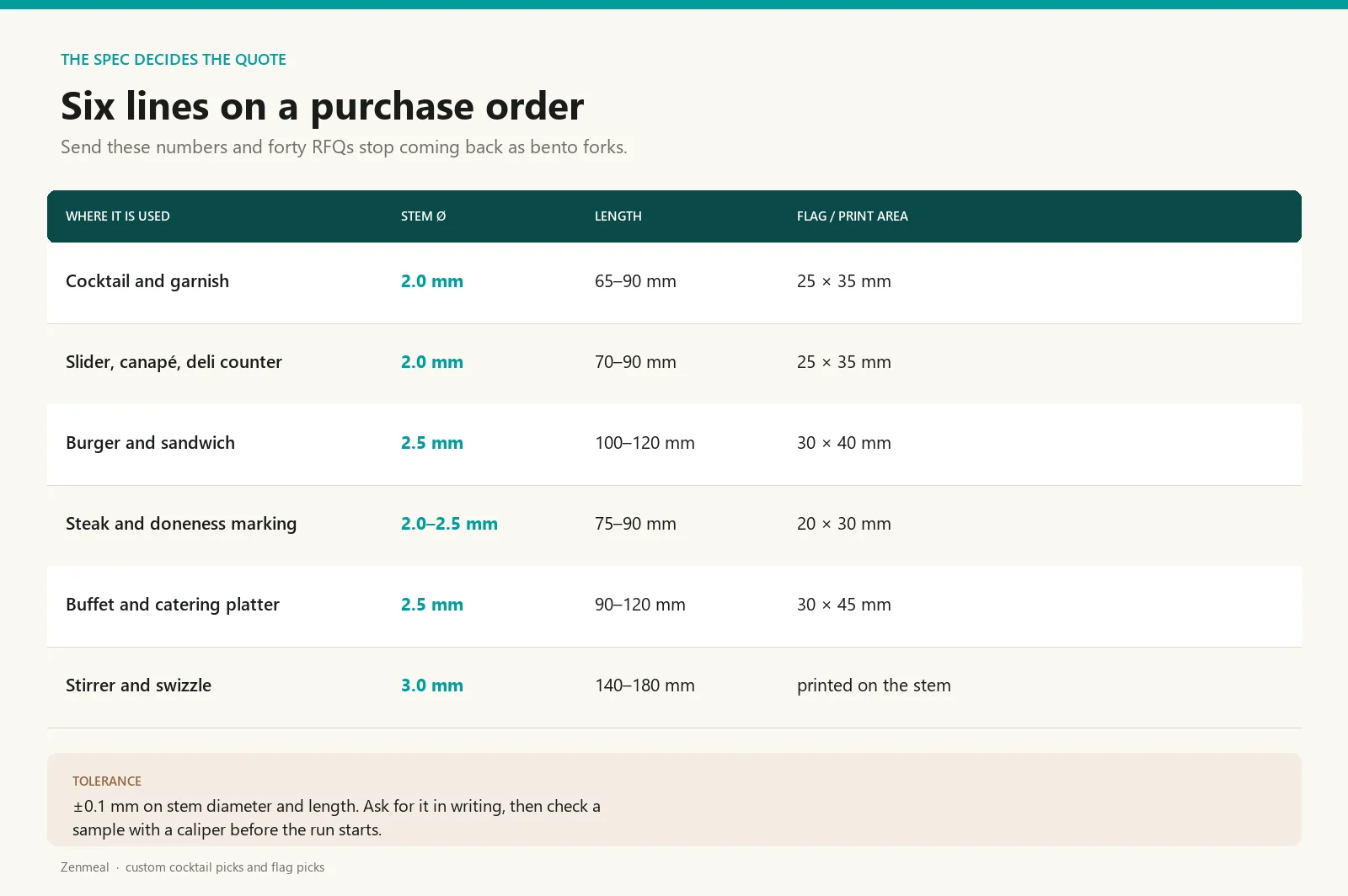
A supplier who has run flag picks before will ask about the flag size and the stem before naming a price. One who has not quotes the photograph. Write these six lines and the second kind filters itself out.
Line on the RFQ
What to write
Why it moves the price
Flag size
25 × 35 mm, finished
Sets paper yield per sheet, and the printable area left after the fold
Stem diameter
2.0, 2.5 or 3.0 mm
Round bamboo is graded by diameter; 2.0 mm and 2.5 mm are different supply lines
Stem length
65, 90 or 120 mm
Decides carton length, and carton length decides how many fit in a container
Paper
200 gsm food-grade, uncoated
Coated stock prints sharper and cockles faster against a cold drink
Adhesive
Hot-melt, service temperature above 70 °C
The line most quotes leave out, and the one that fails first in service
Print
Offset, both sides, three spot colors
Process color on a 25 mm width is a different press with a different minimum
Six rows, and none of them is a product name. That is the point.
What the flag size actually buys you
A 25 × 35 mm flag is 875 mm² of paper and about 600 mm² of usable design space once the fold and a three-millimeter safety margin take their share. That margin is not decoration. A two-millimeter registration shift eats two thirds of it, and a shift that size sits inside normal tolerance on a small-format press. It is also why a printed wordmark looks comfortable in a digital proof and cramped on the plate: the proof had no fold and no margin.
Where the tolerance hides
Stem diameter is quoted to ±0.1 mm and it is checked with a caliper, not with an eye. A 2.0 mm pick that arrives at 1.8 mm flexes under a loaded burger and snaps at the shoulder — the flag is perfect, the pick is in the plate. Above roughly 150 g of load, specify 2.5 mm and stop negotiating it. The working numbers by dish height are set out in our notes on matching pick length to dish height.
The ten, at a glance
Smallest order figures are what each company publishes, not what a salesperson will agree to on a quiet Friday. Treat them as the entry price of a conversation.
Supplier
Base
Smallest order they publish
Built for
Zenmeal
Foshan, China
By the carton
Private label at volume
Unique Manufacturing
Plain City, OH
20,000 (stock master case)
US-origin volume programs
Global Flags Unlimited
Acworth, GA
100 pieces
Small runs with US paperwork
AGAS Manufacturing
Philadelphia, PA
1 piece
Promotional and event deadlines
Cocktail Kingdom
New York, NY
Stock items
Reusable bar-grade picks
Restaurantware
City of Industry, CA
Case quantities
One invoice for the whole table
PacknWood
New York, NY
Case quantities
Bamboo and wood presentation
Bar Products
Clearwater, FL
Each or case
Restocking, not branding
WebstaurantStore
Lancaster, PA
Each or case
Stock, delivered this week
Paper Mart
Orange, CA
Case quantities
Party and packaging bundles
The ten in detail
1. Zenmeal — private label at volume (this is us)
Base: Foshan, Guangdong · Order: by the carton · Prints: flag artwork, stem marking, packaging
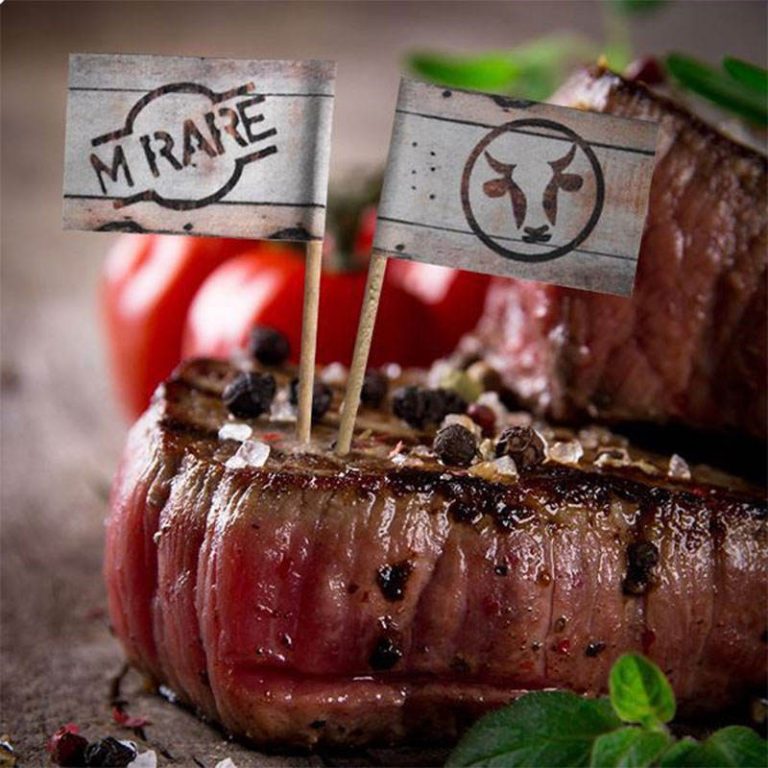
One purchase order can cover a buffet, a grill station and a bar: national flag picks, steak doneness picks, burger picks, beaded cocktail picks, bamboo stirrers, plastic swizzles. Bamboo, birch and printed paper, inspected on the way in and on the way out, packed 100 to a bag and 100 bags to a carton — the count a distributor reorders without recalculating. Most of our own volume sits in the custom flag toothpick line.
What it costs you: an ocean leg, and a calendar measured in weeks rather than days. If a program dies in October and revives in December, a domestic quick-turn shop fits better. If you are building a private-label range and can plan a quarter ahead, the arithmetic works, and the flag, the stem and the bag can carry the same logo.
Ask us: for the proof schedule in dates, not in durations.
2. Unique Manufacturing — US-origin volume
Base: Plain City, OH · Since: 1987 · Prints: high-gloss paper flags on bamboo stems
The reference plant in this category, and where most national rollouts end up. Stock flag picks ship in master cases of 20,000 — four boxes of 5,000, each holding 100 bags of 50 — in the standard sizes of 1.5 × 1 in and 1.75 × 1.25 in. Custom printing runs on the same presses, which is the reason their catalog reads the way a US buyer searches.
The thing worth establishing before you commit is where their clock starts: at the purchase order, or at proof approval. Two words, and on a long program they can be three weeks apart.
Ask them: whether your flag size fits an existing die or needs a new one cut.
3. Global Flags Unlimited — the small-run American option
Their own description is the useful part: a flag company that moved into toothpick flags as a niche and now calls itself the only company producing toothpick flags of any kind in the United States. The stated range runs from 100 pieces to 100,000, with 10,000 to 100,000 described as normal operation. If US origin is a contract term and the quantity is small, the alternatives really are thin.
Small-lot pricing is what small-lot pricing always is. Use them as a sampling channel and a domestic benchmark, not as a route to a few cents a pick.
Ask them: what the per-unit price is at 1,000 against 20,000. The answer tells you where their setup cost sits.
4. AGAS Manufacturing — the deadline order
Base: 2701 E Tioga St, Philadelphia, PA · Minimum: none published · Turnaround: 2–3 weeks on toothpick flags
AGAS publishes what most of this list does not: no minimum order, one flag or ten thousand; toothpick flags in two to three weeks after artwork approval; straw flags in five to seven business days from fifty pieces. Paper, molded plastic, umbrella and banner formats sit under one roof, so a mixed event order does not become four suppliers.
Speed and small lots carry a per-unit premium, and multi-color work gets expensive below a few thousand pieces. For a trade show or a single-location launch, that is the correct trade to make.
Ask them: which flag shapes are stock dies, so you can skip tooling entirely.
5. Cocktail Kingdom — the pick a bartender keeps
Base: New York, NY · Order: stock items · Does not: disposable volume
Not a disposable supplier, and not pretending to be. This is where a beverage program buys the garnish pick that turns up in photographs and survives a thousand washes: stainless and plated, bar-grade weight, catalog designs.
None of it solves a 200,000-piece program, and logo work stops where the catalog stops. Buy here for the ritual, not for the volume.
Ask them: nothing. Read the catalog.
6. Restaurantware — one invoice for the whole table
Base: City of Industry, CA · Order: case quantities · Prints: no
Breadth is the product. A restaurant opening can put bamboo picks, tasting spoons, boats and takeaway packaging on one order with one freight bill, and the eco-positioned range answers a packaging conversation the operator is already having.
Pick-level customization is thin: sizes and flags follow the catalog, and no artwork program sits behind the pick. If the logo on the flag is the whole point, this is the wrong aisle.
Ask them: whether the picks are their own import or bought in. It changes the lead time more than the price.
7. PacknWood — bamboo and wood presentation
Base: New York, NY · Order: case quantities · Origin: US arm of a French group
Skewers, mini picks, cones, boats — the pieces that decide how a plate photographs in a delivery app. Caterers find things here that a general distributor does not stock, and a US warehouse means US invoicing and no import file to manage.
Custom flag printing is a special request rather than a program, and the goods are imported, so the price carries a landed margin you are paying for convenience.
Ask them: which items are held in the US warehouse and which ship in from France.
8. Bar Products — the Tuesday restock
Base: Clearwater, FL · Order: each or case · Prints: no
The pragmatic stop for a bar manager replacing consumables: plastic swizzle sticks, basic picks, garnish tools, priced for a mid-week order rather than a brand launch.
Generic stock, no print program, commodity grade. Useful for operations and useless for branding, and both of those are true at once — which is exactly why the price looks the way it does.
Ask them: the pack count. The per-each price hides it.
9. WebstaurantStore — the bin is empty
Base: Lancaster, PA · Order: each or case · Strength: stock depth
When the requirement is two thousand picks by Thursday, this is the answer, and nobody else on this list competes with that sentence. Stock depth plus same-week shipping is the entire value proposition.
Zero customization in this category. What ships is what is in the bin, and nothing in it carries a printed flag.
Ask them: the case pack, before you compare it with a quoted carton. It is rarely the same number.
10. Paper Mart — party and packaging together
Base: Orange, CA · Since: 1921 · Order: case quantities
A packaging distributor that has sold party supplies since 1921, with the picks shelved next to the favor bags and the boxes. An event or gift business can build a bundle here instead of a tabletop program.
Consumer-grade picks, no print program. If your buyer expects a logo on the flag, keep looking.
Ask them: whether the picks are rated for food contact in a commercial setting or sold for retail decoration only.
Three more worth a quote if the first ten do not fit: Oriental Trading Company (Omaha, NE), Shindigz (South Whitley, IN) and World Centric (Rohnert Park, CA). None of them runs a custom flag program.
What the pick costs after the container
Unit price is the number buyers compare and the number that matters least. Picks cube out long before they weigh out: a forty-foot container fills with cartons while it is still nowhere near its weight limit, so carton dimensions — not the piece price — set what you pay per pick once the goods are in your warehouse.
Three lines every quote should carry
Line
What its absence looks like
FOB price per 1,000, by size
One blended unit price covering five sizes
Carton count and carton dimensions
“Standard export carton”, which can run 40% more cube
Trade term
“FOB” sitting on an EXW price, or a DDP price with no duty line inside it
A quote that arrives with a price and nothing else is not comparable to another quote. Ask for the other two lines and the comparison takes ten minutes instead of a week.
Carton count is a design decision, and it is cheaper before the run
A hundred thousand picks in three sizes is ten cartons at 10,000 to a carton, twenty at 5,000 — the same goods, one extra pallet position, and part of a container slot you paid for. Nobody wins that argument after the boxes are made. Settle it in the RFQ, next to the flag size.
Four ways a printed flag fails in service
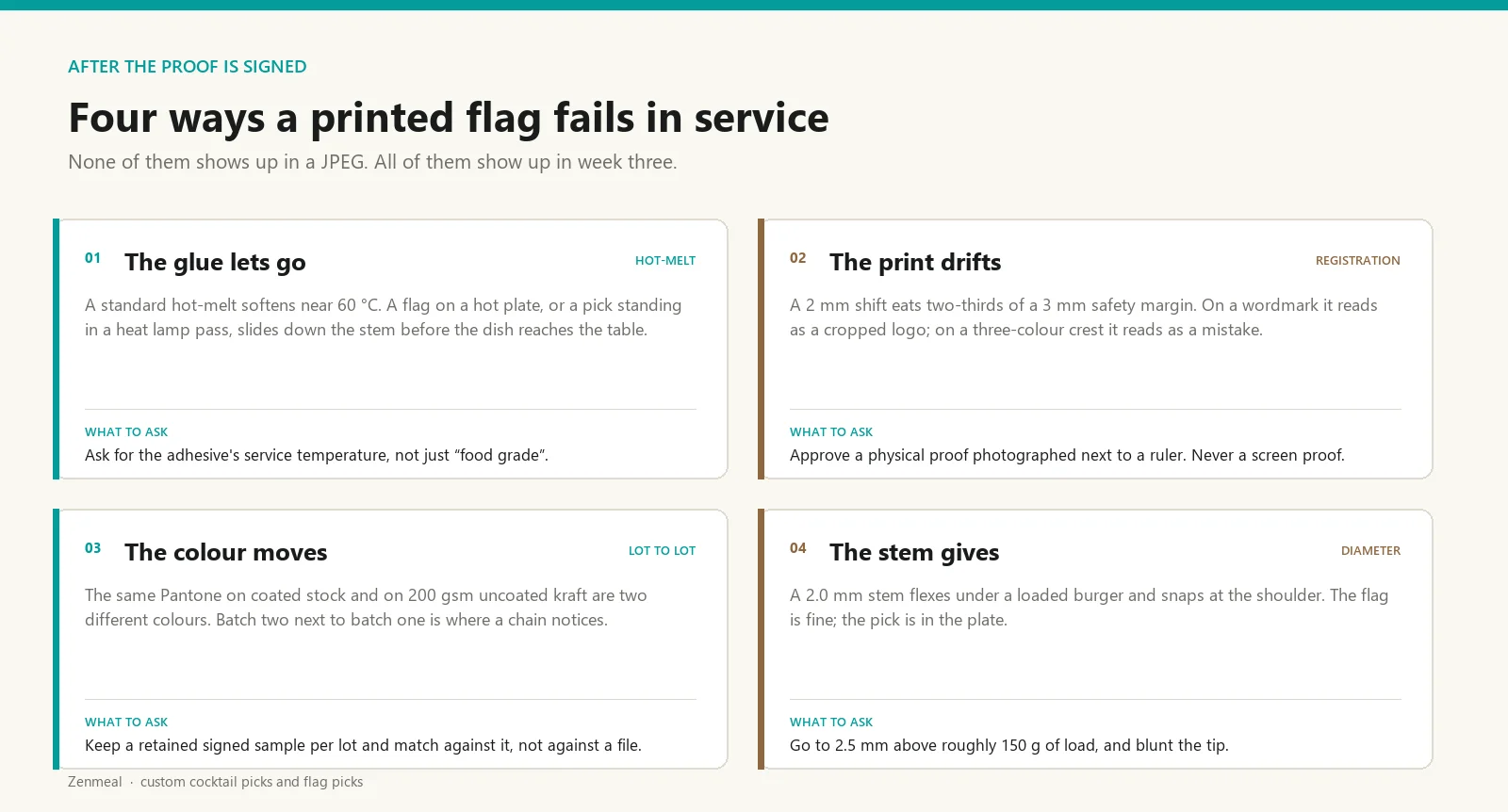
All four pass a photo proof. That is the point of the section: the proof is not the test. The card below is the version worth sending to a colleague who signs off artwork.
Four failure modes, and the one question that prevents each.
If the flags are all down the stem and the print is perfect
That is the adhesive, not the printer. Check the serving temperature of the dish against the service temperature of the hot-melt before you blame the run.
If the wordmark is intact but crowded
Registration, and it happened at the press. It is also the one failure a screen proof cannot show you, because the safety margin only exists on paper that has been folded.
If batch two looks a shade off beside batch one
Coated against uncoated, or two ink lots on the same stock. A signed retained sample per lot settles the argument in two minutes; a Pantone number alone does not.
If the pick is in the plate and the flag is on the table
Diameter, or a tip that was polished too sharp. Both are visible with a caliper and a thumb, on the sample, before the run.
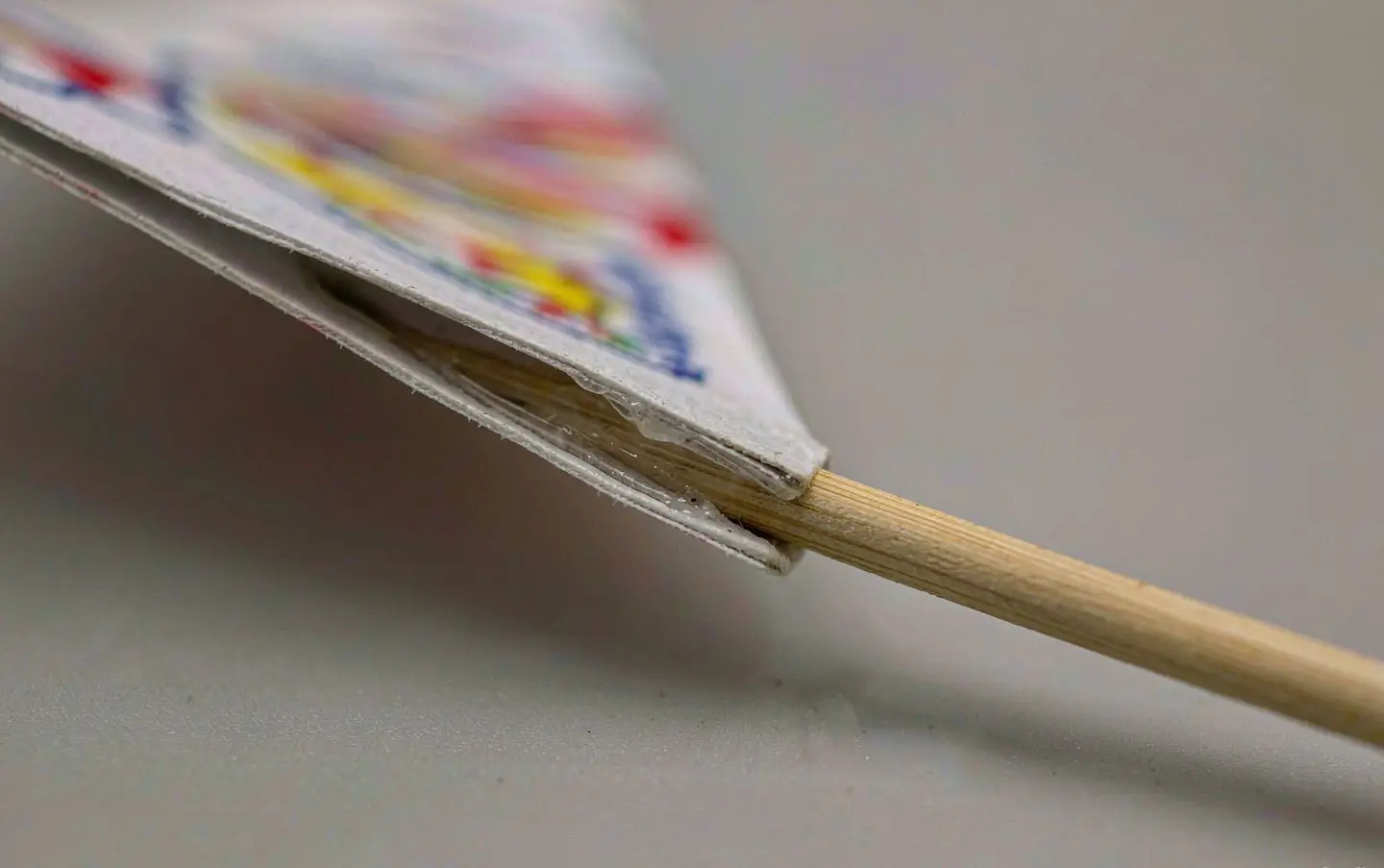
The glue line is two millimeters wide and it is where most service failures start.
How to run the sample round without losing a month
Stock samples are usually free or freight-only and they prove nothing about your artwork. The round that matters has three fixed points, and skipping any one of them is how a reprint happens — and a reprint always costs more than the proof.
Approve a physical proof photographed next to a ruler. A flat PDF cannot show you the fold, the bleed or the paper’s reaction to ink.
Sign the flag, the stem and the bag, not just the flag. Three components, three opportunities for a substitution nobody logged.
Keep one signed sample from the approved lot, and date it. When batch two arrives in March, the conversation needs an object, not a file.
Ask for the schedule in dates. “Two weeks for the proof” is a duration, and durations slide; “proof on the 14th, your approval by the 18th, press on the 19th” is a plan you can hold someone to, including us.
Frequently asked questions
Is anything in this category still made in the United States?
Some of it, and less than buyers expect. ToothpickFlag.com describes itself as the only US company producing toothpick flags of any kind; Unique Manufacturing and AGAS print stateside. Nearly every bamboo or birch stem is imported. If US origin is a contract term, price domestically first and treat the import route as the fallback.
What is a realistic minimum for custom printed flag picks?
It spans four orders of magnitude, and all of it is published somewhere. AGAS quotes from one piece, Global Flags Unlimited from 100, Unique ships stock in master cases of 20,000, and an overseas factory sells by the carton. Start from your annual usage and work backwards: a minimum that takes two years to consume is a storage problem wearing a discount.
How long does production actually take?
Domestic small-lot work runs in weeks — AGAS publishes two to three weeks on toothpick flags after artwork approval. A factory order is roughly a month of production plus four to six weeks on the water, and the ocean leg is the part that does not compress. Door to door, plan in quarters rather than weeks, and add time in the fourth quarter when every seasonal program lands at once.
Are cocktail picks, flag picks, toothpick flags and food picks the same product?
One object, five regional names. UK buyers say food flags, US foodservice says toothpick flags, bars say cocktail picks or garnish picks, the party aisle says party picks. Specify size, stem diameter, paper weight and print method instead of a name, and the quotes start arriving for the right product.
What food-safety paperwork should I ask for?
A written declaration for the adhesive and any coating against FDA 21 CFR 175.300 for the US market, ink migration data for the printed area, FSC paperwork if the paper is certified, and retained samples by lot. Ask before the deposit; a supplier who has the file will send it the same day, and that is itself the test.
Can I get a sample before committing to a run?
Yes, and refusing to skip it is the cheapest decision in the project. Stock samples are usually free or freight-only; a custom proof usually carries a charge that comes off the order. Ask for the proof photographed against a ruler, on your paper stock, with your artwork in its final colors.
Which one fits your order
Route by shape, not by ranking. Need US origin, a few hundred pieces, or delivery next week? Stay domestic: Unique for volume with American paperwork, Global Flags Unlimited at 100 pieces, AGAS when the date is fixed by an event, WebstaurantStore when the bin is already empty. Need a private-label line of custom cocktail picks at a landed cost that survives a distributor’s margin? That is factory work, and a container is the unit of purchase.
We quote a full pick family by carton count and hand you a dated proof schedule before production starts. Your customer never sees the purchase order. They see whether the flag is straight and whether the pick holds the burger.
Request a quote from the factory
Zenmeal manufactures flag picks, steak doneness picks, burger picks, party picks, beaded cocktail picks, cheese picks, bamboo stirrers and plastic swizzle sticks for distributors and importers.
The whole pick family from one factory, so one purchase order covers the table and the bar.
Bamboo, birch and food-safe plastic, with incoming and finished-goods inspection.
Flag artwork, stem marking and packaging customization, including OEM specifications.
Carton counts and lead times planned around seasonal programs, not quoted from a template.
In various catering parties of 2026, confusing pizza flavors on buffet tables, unclear labeling of snack dips, and the lack of thematic decorations on dessert tables are still common pain poin...
Party picks falling off during long-distance shipping and turning into bare sticks are one of the most troublesome quality issues for catering decoration procurement. In the enclosed and harsh...
A tiny cocktail pick can break your bar’s reputation. Picture this: a busy night, a dim room, and a customer enjoying a signature drink. Suddenly, they choke on a loose wooden bead or ba...


 Español
 Français
 Deutsch
 Português
 Русский
 العربية
 简体中文
 Italiano
 日本語
 한국어
 Türkçe
 Tiếng Việt
 ไทย
 Indonesia
 Melayu