National Flag Picks for International Hotels: A Case Study on Country-Coded Food Picks in Buffet and Banquet Service
A banquet manager at a five-star hotel in Singapore was preparing a welcome dinner for 300 delegates from 18 countries. The buffet had six regional stations — Japanese sushi, Italian antipasti, Middle Eastern mezze, Korean banchan, French charcuterie, and Indian tandoor. Each station had been assigned a server to answer the same question all evening: “What is this?”
By the second hour of service, the banquet manager counted the questions. The Japanese sushi station alone had been asked 47 times. The French charcuterie station, 38 times. Across six stations, the serving team had answered roughly 240 questions — the equivalent of one full-time server doing nothing but identifying dishes for three hours straight.
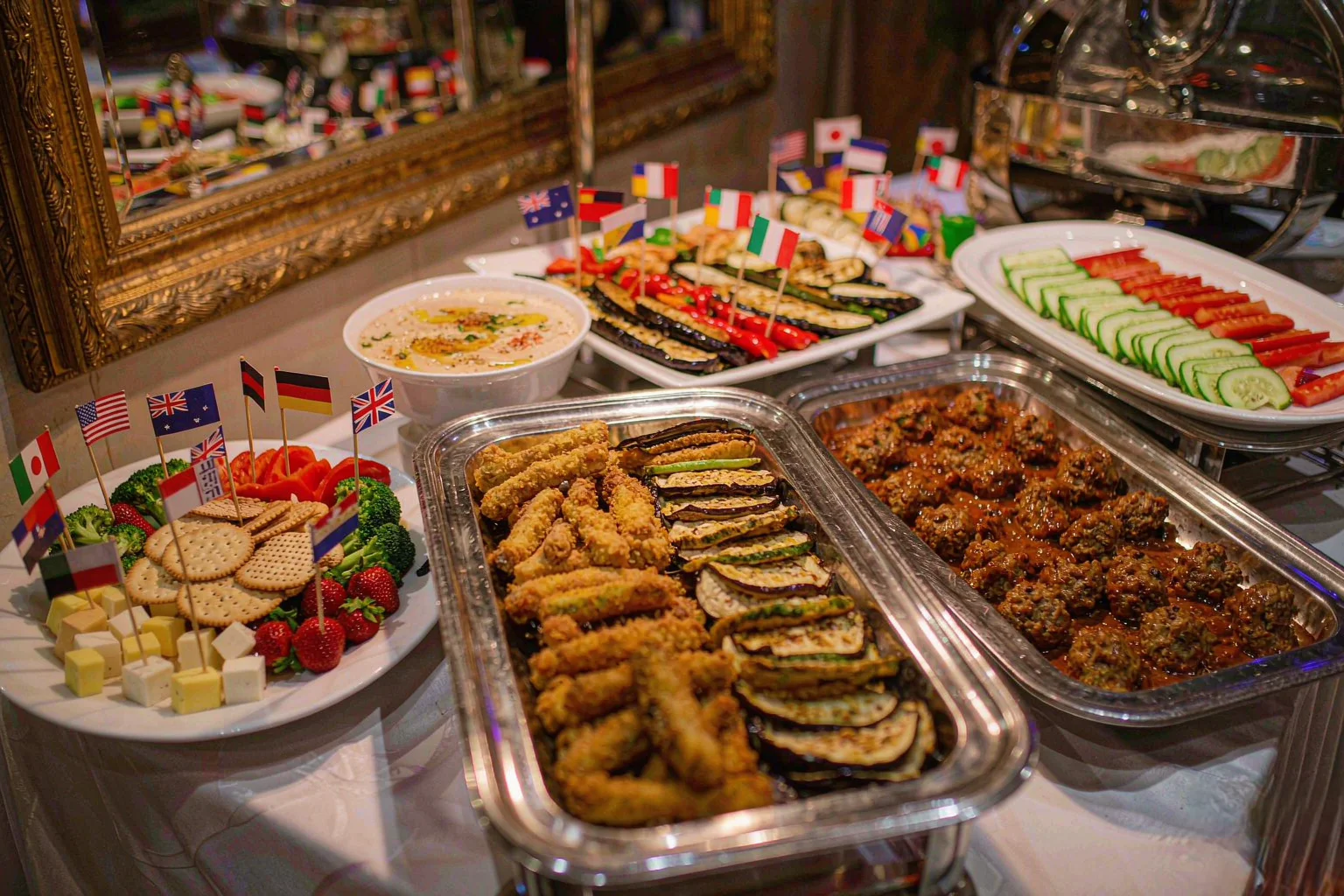
For the following month’s international conference dinner, the hotel tested a different approach. Each regional dish was marked with a national flag pick — a small bamboo stick topped with a food-grade film flag printed with the country’s national colors. The Japanese flag marked the nigiri platter. The Italian tricolor marked the prosciutto skewers. The Korean Taegukgi marked the banchan spread.
The question count dropped to near zero. Guests identified dishes at a glance, picked what they wanted, and moved through the buffet line without stopping to ask. The hotel’s service team was freed to focus on replenishment and guest engagement rather than repeated identification. The flag picks cost less than $40 for the entire event. The labor they replaced was worth roughly $180 per service hour.
This case study breaks down what national flag picks are, where they solve real operational problems in hotel and catering environments, how to customize them, and what to specify when ordering for a B2B account.
The Challenge: Identification Without Friction
The Singapore hotel’s problem is universal in international catering. Any buffet serving multiple regional cuisines faces an identification gap: the guest does not recognize every dish, the menu card gets misplaced or ignored, and the serving team becomes a walking label service.
The standard solutions all have weaknesses. Printed menu cards on the buffet table get stained, knocked over, or simply not read in a dim banquet hall. Printed tent cards next to each dish take up valuable platter space and look institutional. Verbal identification from servers ties up labor that should be focused on guest experience and replenishment.
National flag picks solve the problem at the dish level. The flag is inserted directly into the food or placed on the platter edge — it travels with the dish, it is visible from across the room, and it requires no reading of text in a language the guest may not share. A flag is recognized instantly, regardless of the guest’s native language.
What National Flag Picks Actually Are
A national flag pick has three components: the flag (a printed paper or food-grade film rectangle), the pole (a bamboo or wooden stick, typically 2.5 to 4 inches), and the attachment that bonds the flag to the pole.
The flag is double-sided printed — the national flag design appears on both faces so the pick reads correctly from any angle. Food-grade film flags are waterproof and grease-resistant, suitable for direct contact with moist or oily foods. Paper flags are cheaper but warp and discolor on wet surfaces, limiting them to dry applications.
The pole material determines structural performance. Bamboo is the standard — rigid, food-safe, inexpensive. For more on why bamboo outperforms plastic in food pick applications, see our comparison of bamboo vs plastic swizzle sticks, which covers cost, reuse, and single-use plastic regulations by market.
Where Flag Picks Solve Real Problems
International Hotel Buffets
The primary application, and the one the Singapore case study illustrates. Country-coded markers on each dish serve as silent labels — guests identify dish origin at a glance without menu cards or server intervention.
Hotels that switch from unlabeled buffet dishes to flag-pick markers report a 30-40% reduction in guest questions to serving staff during peak service. The labor savings per service hour roughly equals one part-time server’s wage — a return that pays for the picks within the first week.
Diplomatic and Government Banquets
Events with foreign dignitaries, ambassadors, or trade delegations require careful flag representation. Every dish associated with a specific country must carry the correct, current national flag — not a similar-looking variant, not an outdated design, and not the flag of a politically sensitive neighbor.
For these accounts, the supplier must guarantee flag design accuracy using vector artwork from an approved source. The B2B buyer should request individual artwork approval before production. For related guidance on sourcing from reliable manufacturers, see our comparison of 10 custom cocktail pick and flag pick manufacturers.
Airline and Cruise Catering
First-class and business-class meal service on international routes uses flag picks to identify meal components by destination cuisine. Cruise lines use them at themed dinner buffets corresponding to port-of-call destinations. Aviation security limits pole length — flag picks for airline catering typically use 2.5-inch poles rather than the standard 4-inch.
Corporate Events and Conferences
Multinational corporations hosting international conferences use flag picks at welcome receptions to acknowledge attendee diversity. An event with 200 delegates from 30 countries might order 30 flag designs, 200 picks each. This is a high-customization, low-volume order that requires a supplier capable of short-run production. For design considerations in custom pick sourcing, see our eco-chic party bamboo pick sourcing and design guide.
The Solution: Customization Specs That Work
Flag Material
Material
Cost
Water Resistance
Best For
Food-grade film
Higher
Waterproof, grease-proof
Direct food contact, moist dishes, oily foods
Coated paper
Medium
Splash-resistant
Dry foods, low-moisture presentation
Uncoated paper
Lowest
None
Budget accounts, dry display only
For hotel buffet and banquet use, food-grade film is the recommended default. The premium over paper is typically 15-20% in volume, and the performance difference is significant — film flags survive contact with olive oil, soy sauce, and marinades without bleeding or discoloring.
Pole Length and Material
Length
Application
2.5″ (63 mm)
Cocktail garnishes, airline catering, small canapés
4.0″ (100 mm)
Standard buffet picks, hors d’oeuvres, fruit skewers
6.0″ (150 mm)
Large platter markers, sandwich picks, steak markers
Custom flag picks typically require a minimum of 5,000 pieces per design, with 15-20 day production. Suppliers with stock flag designs (the 30 most common national flags) can ship within 7 days at lower MOQs — sometimes as low as 1,000 pieces per design. For multi-design orders, negotiate a combined MOQ rather than a per-design minimum.
Flag Etiquette: Three Pitfalls That Catch Uninformed Buyers
Flag picks are decorative, but national flags carry political and cultural significance. Three pitfalls catch uninformed buyers.
Outdated flag designs. National flags change. Myanmar adopted a new design in 2010. Afghanistan changed in 2021. Always verify flag designs against a current reference before approving artwork.
Similar flags confused. Chad and Romania have nearly identical tricolors. Indonesia and Monaco share the same red-over-white design. Ireland and Côte d’Ivoire use the same colors in reverse. Cross-check each flag against the guest list country by country.
Flag orientation. Some flags are not symmetrical. The Saudi Arabian flag includes the Shahada and must never be inverted — placing it upside-down is a serious offense. Flags with text or directional symbols require orientation verification during quality control.
Commercial Considerations: ROI Beyond Unit Cost
The unit cost difference between a flag pick and a plain bamboo pick is small. A plain bamboo pick in volume costs $0.002-$0.004. A custom flag pick costs $0.008-$0.015. The premium is 3-5x.
The ROI is not about unit cost. It is about the value the flag pick creates:
Labor savings: One flag pick per dish replaces 5-10 guest questions per service hour. At a hotel with 200 buffet covers, savings equal 2-3 server-hours per service.
Allergen safety: Country-coded picks help guests identify dishes with region-specific allergens. One prevented allergic incident pays for a year’s supply.
Social media exposure: Flag-decorated buffet platters are photographed and shared. A single guest Instagram post is free marketing with reach that paid advertising cannot replicate.
Brand perception: International hotels using country-coded picks signal cultural awareness — noticed by corporate event planners who select venues for international conferences.
If your hotel, catering company, or event management business is sourcing national flag picks for international buffets, diplomatic banquets, or corporate events, Zenmeal specializes in flag picks and decorative party picks for global B2B clients — distributors, importers, foodservice suppliers, and OEM/ODM projects. Contact us for a customization consultation, or browse our national flag picks catalog.
For EU-market compliance considerations that affect pick packaging, see our analysis of EU PPWR packaging rules entering into force in 2026.
For practitioners in the catering industry, the safety and sealing of food during delivery have always been a crucial operational detail. Ordinary sticker seals easily fall off when exposed to...
For chain catering brands providing nationwide burger delivery services, the small Toothpick Flags are often the most easily overlooked detail that directly affects brand image. Bumpy delivery...
Edible Flags are quietly revolutionizing the decoration style of wedding dessert tables. For a long time, paper flags have been widely used to adorn wedding desserts, yet they come with obviou...


 Español
 Français
 Deutsch
 Português
 Русский
 العربية
 简体中文
 Italiano
 日本語
 한국어
 Türkçe
 Tiếng Việt
 ไทย
 Indonesia
 Melayu