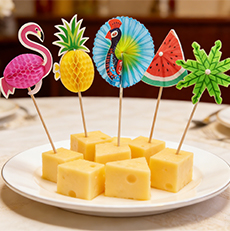
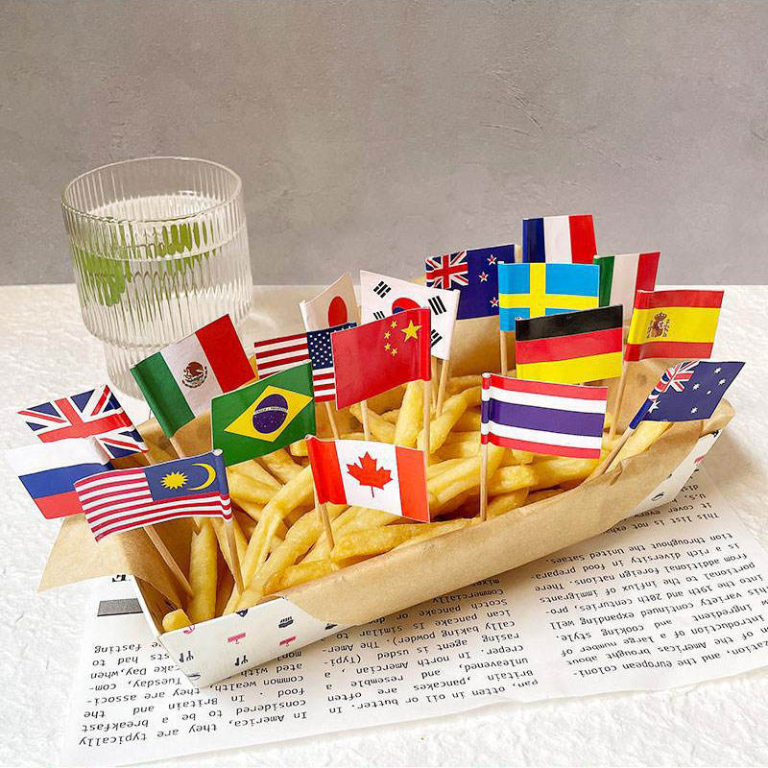
Flag Picks Dual Compliance: Food Contact & Labeling – Why Far More Complex Than Ordinary Bamboo Sticks?
Many practitioners focused on catering supply customization will simply regard flag picks as bamboo sticks with printed patterns, unaware that this cognitive bias exactly hides compliance risks. A seemingly tiny flag pick has dual core attributes naturally: it must meet the strict requirements of food contact materials and abide by the norms of food label management. The production threshold of food-grade flag picks is several times higher than that of ordinary bamboo sticks with single material. In the whole process of compliant flag pick customization, any oversight in any link may lead to the finished product being unavailable, which is the core bottom line that professional custom manufacturers must adhere to.
Many people wonder why ordinary bamboo sticks only need to control the environmental protection and cleanliness of bamboo itself, while flag picks are included in the dual regulatory system. The answer lies in its application scenarios. Flag picks are directly inserted into cakes, cocktails, hot drinks, cooked food and other foods, and the paper, printing ink and adhesive will all contact food directly or indirectly, belonging to the category of legal food contact materials. At the same time, the brand names, product descriptions and decorative slogans printed on flag picks have the function of food labels, and the text content and pattern design must comply with relevant labeling specifications. The superposition of dual identities means that flag picks must pass the assessment of two regulatory systems at the same time, which is the compliance pressure that ordinary bamboo sticks never face.
To create qualified food-grade flag picks, the three core elements of paper, ink and adhesive have insurmountable standard red lines, all adopting the latest national standard requirements:
1. Paper Selection: The Basic Defense Line for Food Contact
The paper of flag picks is the first carrier in contact with food, and the adaptability and compliance of different materials vary widely. The comparison of mainstream materials is clearly visible:
Coated paper: full printing color, high detail restoration, suitable for high-end visual customization, but with coating on the surface, focusing on coating compliance verification
Synthetic paper: waterproof, oil-resistant and tough, suitable for cold drinks and humid scenes, but harmful plastic additives must be eliminated
Plastic-free paper: no coating, no plastic additives, the best choice for food direct contact flag picks, only slightly inferior to coated paper in printing accuracy
In accordance with the current mandatory standards, all flag pick paper directly contacting food must strictly comply with GB 4806.8-2022 standard for paper materials used in food contact, which is an uncompromising basic requirement.
2. Ink Selection: The Core Key to Preventing Component Migration
Ink is the most error-prone link in flag pick compliance. Hot, humid and oily environments will accelerate the migration of ink components to food, which is a risk that ordinary bamboo sticks do not have. The latest implemented GB 4806.14-2023 clearly stipulates that all components of ink used for flag picks must be listed in the GB 9685 positive list of additives for food contact materials, and unregistered harmful components are prohibited.
In actual production, flag picks directly contacting food shall preferentially use water-based food-grade ink; UV ink is selected for non-direct contact scenarios, and complete curing must be ensured to avoid residual harmful substances.
3. Adhesive Selection: An Easily Overlooked Invisible Compliance Point
The adhesive bonding flag picks and bamboo sticks is often ignored as an auxiliary material, but it also belongs to a part of food contact materials. The components of the adhesive must comply with the requirements of the GB 9685 positive list, and manufacturers need to obtain complete compliance statements and test reports from suppliers to prevent overall compliance failure caused by small auxiliary materials.
The compliance requirements for flag picks vary greatly in different application scenarios. Combined with actual application needs, a precise selection table is sorted out for quick matching:
Application Scenario
Recommended Paper
Recommended Ink
Core Testing Requirements
Hot Drinks/Coffee Matching
Plastic-free Paper
Water-based Food-grade Ink
Qualified 60℃ hot and humid migration test
Cold Drinks/Cocktail Decoration
Synthetic Paper
UV Cured Ink
Immersion resistance, no component precipitation
Cake/Dessert Decoration
Coated Paper/Plastic-free Paper
Water-based Food-grade Ink
Qualified oil environment migration test
Chain Catering Customization
Plastic-free Paper
Water-based Food-grade Ink
All food contact tests qualified
Takeaway Sealed Packaging
Plastic-free Paper
Water-based Food-grade Ink
No migration in high-temperature closed environment
In the communication and production of flag pick customization, we have collected the most representative high-frequency questions in the industry and given answers combined with practical experience:
Q1: Can gold powder and silver powder decorations on flag picks be used in food contact scenarios?
A: Metal pigment inks mostly contain heavy metals such as lead and cadmium, with clear component migration risks. Flag picks directly contacting food are strictly prohibited from using them. It can be replaced by physical bronzing process, or metal decorative effects can be abandoned to prioritize food safety.
Q2: The supplier promises to use food-grade ink, how to effectively verify the authenticity of qualifications?
A: The supplier is required to provide three core documents: GB 4806.14 compliance statement, third-party authoritative institution migration test report, and GB 9685 positive list component statement of the ink manufacturer, and the test samples must be completely consistent with the actual customized products.
Q3: When customizing flag picks, how to control the whole-process compliance risks?
A: Choose custom manufacturers with experience in food contact product production, and require test reports and compliance certificates throughout the process from raw material procurement, production and processing to finished product quality inspection. Gorlando has specialized in disposable tableware customization for many years, and strictly implements dual regulatory standards in flag pick production and customization. We select compliant raw materials in the whole chain from paper, ink to adhesive, providing safe, stable and compliant flag pick solutions for various catering scenarios.
Q4: The printing effect of plastic-free paper flag picks is poor, is there a scheme that balances aesthetics and compliance?
A: Food-grade plastic-free coated paper can be selected, which not only retains the plastic-free safety attribute, but also improves printing accuracy. Combined with water-based food-grade ink, it can balance visual effect and food contact compliance, suitable for high-end catering customization needs.
Q5: What are the restrictions on the label content of flag picks?
A: As a food label carrier, flag picks are prohibited from printing false propaganda, medical effects, illegal certification and other content. Text and patterns must be clear and standardized, complying with relevant labeling management requirements to avoid finished product scrapping due to illegal content.
The small flag pick carries the strict requirements of dual supervision, and also tests the professional ability of custom enterprises. Putting aside the decorative attributes on the surface, adhering to the bottom line of dual compliance for food contact and labeling is the core for flag picks to be safely applied in various catering scenarios. Gorlando always controls the whole process of flag pick production with high standards, and provides reliable choices for catering supply customization with professional and compliant products.
An urgent quality rejection notice landed on the desk of Gorlando’s internal quality control team, informing the team that an entire batch of disposable cocktail picks got rejected solely due ...
Beaded Picks are often treated as minor bar smallwares, yet a single poorly engineered skewer can destroy a $18 craft cocktail during a busy weekend service rush. When a heavy blue-cheese stuffed ...
Crispy fried chicken, juicy sauce-covered burgers, and oil-soaked snacks paired with delicate Flag Picks not only hold food ingredients firmly but also enhance the visual appeal of meals. Yet ...


 Español
 Français
 Deutsch
 Português
 Русский
 العربية
 简体中文
简体中文 Italiano
 日本語
日本語 한국어
한국어 Türkçe
 Tiếng Việt
 ไทย
ไทย Indonesia
 Melayu